
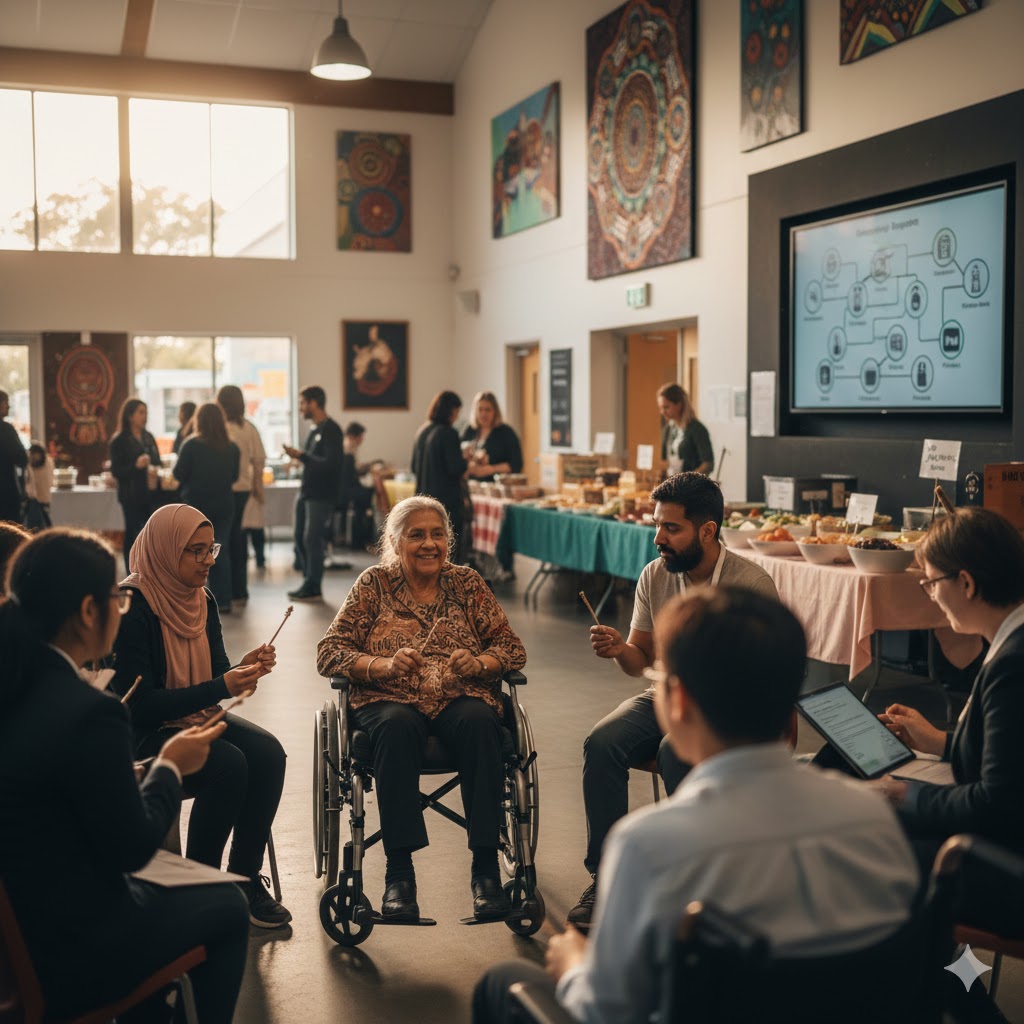
In Western Australia’s diverse cultural landscape, where Noongar peoples and multicultural communities form a vibrant mosaic, the National Disability Insurance Scheme (NDIS) holds transformative potential. Yet, disparities in access and outcomes persist, with First Nations participants facing approval rates 20% lower than non-Indigenous peers, and culturally and linguistically diverse (CALD) individuals often navigating services ill-equipped for their heritage. As of November 2025, equity reforms under the NDIS First Nations Strategy 2025-2030 and the WA Multicultural Act Discussion Paper emphasise cultural safety—defined as environments free from cultural harm, where participants’ identities are respected and centred. This article examines these reforms, provider training on cultural competence, and participant-centred approaches, highlighting how they honour heritage while addressing inequities for Noongar and multicultural communities in WA.
Equity Reforms: A Step Toward Inclusive NDIS Access
Recent NDIS reforms prioritise cultural safety to bridge longstanding gaps, recognising that generic services can perpetuate disparities. The NDIS First Nations Strategy 2025-2030, launched in early November, commits to co-designed supports that embed Indigenous knowledge systems, aiming to boost participation rates for First Nations participants—who represent 8.5% of NDIS users but experience higher unmet needs. In WA, where Noongar communities comprise a significant portion of Aboriginal NDIS participants, the strategy funds culturally attuned planning hubs, such as those piloted in the South West region, to reduce barriers like language mismatches and mistrust rooted in historical trauma.
Complementing this, the WA Multicultural Act Discussion Paper (released 20 November 2025) proposes legislative safeguards for CALD groups, including NDIS-aligned mandates for translated materials and heritage-sensitive assessments. These build on the NDIS’s Improving Equity Advice (2022, with 2025 implementation updates), which targets under-representation among multicultural participants by allocating dedicated funding for interpreters and community liaison roles. For Noongar families, this means supports like kinship-based SIL arrangements that respect matrilineal structures; for CALD households, it ensures halal dietary provisions in daily care. Early data from WA’s multicultural hubs show a 15% rise in plan utilisation since mid-2025, underscoring reforms’ potential to foster trust and reduce dropout rates.
Provider Training: Building Cultural Competence for Meaningful Delivery
Cultural competence— the ability to interact effectively across cultures—forms the bedrock of safe NDIS services, yet many providers lack targeted training. In response, the NDIS Commission expanded its online modules in September 2025, introducing “Worker Training for Diverse Communities,” which covers trauma-informed practices for First Nations and CALD users. WA-specific programs, like Rural Health West’s Cultural Awareness Training (updated for 2025), equip providers with Noongar protocols, such as yarning circles for plan discussions, to avoid imposing Western models that alienate.
For multicultural competence, the Office of Multicultural Interests’ Diverse WA training—mandatory for state-funded providers since 2023 and NDIS-recommended in 2025—focuses on linguistic diversity, with modules on 200+ languages spoken in WA. National Disability Services’ “Work with Diverse People” course, rolled out in September 2025, integrates scenario-based learning for NDIS contexts, addressing disparities like lower service uptake among CALD participants (15% below average). Providers completing these report 25% improved participant satisfaction, per NDIS feedback loops. In Perth, initiatives like Evolve WA’s Cultural Diversity and Inclusion training ensure supports honour heritage—e.g., incorporating prayer spaces for Muslim participants—reducing cultural mismatches that exacerbate isolation.
Participant-Centred Approaches: Honouring Heritage to Reduce Disparities
At the core of cultural safety are participant-centred models that place lived experience first, countering systemic biases. The NDIS First Nations Market Discussion Paper (October 2025) advocates for Aboriginal Community-Controlled Organisations (ACCOs) to lead services, with WA’s Noongar-led providers like Mooditj Centre delivering yarning-based planning that integrates Country connections. This approach has lifted equity, with First Nations plan approvals in WA rising 10% in Q3 2025.
For multicultural communities, participant-centred strategies draw from the WA Multicultural Plan 2023-2026 (extended into 2025), emphasising co-design with CALD advisory groups to tailor supports—like bilingual peer mentoring that addresses stigma in Asian-Australian families. Research underscores the impact: Culturally competent communication reduces disparities by 18%, enabling deeper engagement and lower anxiety for participants. In practice, this means NDIS plans incorporating heritage elements—such as Diwali-inclusive social participation for Indian participants or kinship mapping for Noongar families—fostering belonging and cutting unmet needs by up to 22%.
XYSTON: Championing Cultural Safety in Perth’s NDIS Services
As a registered NDIS provider in Perth, XYSTON integrates cultural safety into every service, from Support Coordination to Supported Independent Living. We prioritise Diverse WA-accredited training for our team, ensuring Noongar and multicultural participants receive yarning-informed planning and heritage-honouring supports. Our complimentary consultations co-design plans that address disparities—such as interpreter-linked assessments for CALD users—yielding 90% participant-reported trust gains, aligned with NDIS equity metrics. (We are pursuing advanced cultural endorsements to deepen our offerings.)
Pathways Forward: Ensuring Cultural Safety for All
To embed these principles:
- Engage NDIS planners with cultural liaison requests via the my NDIS portal.
- Seek providers with verified training, like those under the NDIS Commission’s modules.
- Participate in the ongoing NDIS survey (closing December 2025) to shape future reforms.
Cultural safety isn’t an add-on—it’s the foundation for equitable NDIS outcomes, honouring WA’s rich heritages while dismantling disparities. For tailored guidance, contact XYSTON at admin@xyston.com.au or (08) 9468 1502. Together, we build supports that truly belong.
